The call usually comes in the second week of a cold snap. Your mother says the house feels fine, maybe a little cool at night, and then the electric bill lands at nearly double what it was last January. You are three states away, you cannot put your hand on a vent, and the only decision actually in your hands is picking a heating company ocean city md that will go look at a 1,400 square foot ranch on the north end without you standing over the technician. That choice matters more than any equipment upgrade, because a contractor who documents each visit, sets the maintenance schedule in advance and will speak with a family member who is not in the room turns a remote guessing game into a system somebody is actually watching.
Start with what the equipment is supposed to be doing. A heat pump moves heat that already exists in the outside air into the house rather than manufacturing it, which is why home energy guidance published by the University of Maryland Extension, still current when I read it in August 2026, describes the approach as roughly 60% to 70% more efficient than electric resistance heating. Emergency heat is resistance heating. So when the strips take over for weeks at a stretch, the efficiency you paid for is not in play at all, and the difference shows up on the bill long before anyone in the house notices a draft.
Distance Turns Small Faults Into Big Bills
In practice, the fault is rarely dramatic. A defrost board fails, or a reversing valve sticks, or a low refrigerant charge drags the outdoor unit’s capacity down until the thermostat gives up and calls the backup heat in to finish the job. The house stays livable, which is exactly the problem, because nothing about the situation feels like an emergency to the person living in it. Say the December bill ran $180 and February came in at $340 on the same thermostat setting. From three states away, that $160 gap is the only signal you get, and it arrives about six weeks after the fault started.
A fixed income makes the arithmetic worse. A parent who sees one high bill will often respond by turning the thermostat down, which shaves a little off the next bill and hides the fault for another month. What we see most often is a system that has been running on backup since the first hard freeze, discovered in March, after five billing cycles nobody questioned.
Emergency Heat Is A Symptom Not A Setting
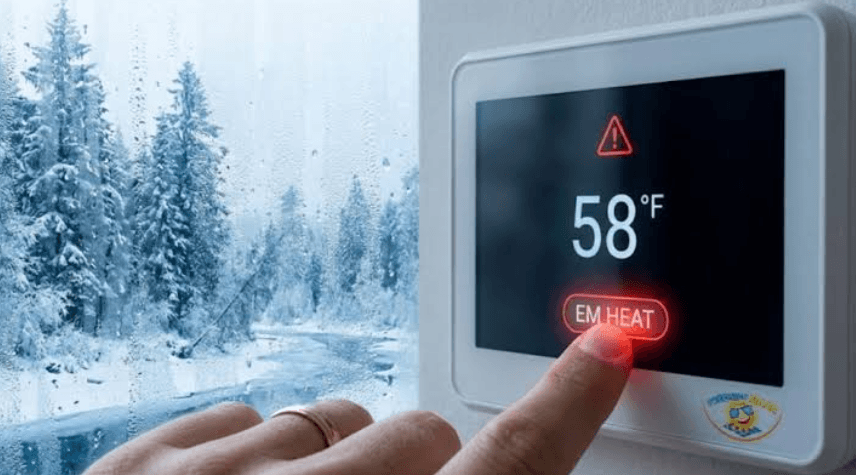
Most heat pumps have an auxiliary or emergency mode, and most thermostats will show it. Some display a small light or the letters AUX, and others say nothing unless you dig into a service menu. The mode exists for a good reason: below a certain outdoor temperature, or during a defrost cycle, the compressor genuinely needs help. A failing heat pump does not announce itself, it just quietly runs up the bill. Continuous operation is the tell. Weeks of it means something upstream has failed, not that somebody bumped a switch.
Here is the rule I give families who cannot get to the house. If the bill jumps by more than half against the same month last year and nobody touched the setting, treat it as equipment and get a technician in the door. If it climbed by a quarter or less, start with settings, filters and whether the back bedroom window has been cracked open since October. I cannot tell you how many shore houses along that stretch are running on backup heat this winter, because nobody tracks it and no utility publishes it, so the honest answer is that the only way to know about one house is to have somebody look at it.
Questions To Ask Before You Hire
Screening a contractor by phone is a different job from screening one at the kitchen table. You cannot read a truck, a uniform or a tool bag, so you are left with what the company can tell you about its own process. Ask about documentation and communication before you ask about price, because the cost of a diagnostic visit is the least interesting number in this decision.
- Will you send a written summary with photos after every visit? A good answer names the format and a turnaround, like a PDF the same day.
- Can you talk to me directly when I am not at the house? A good answer explains how permission gets on file and who calls whom.
- How do you check whether the auxiliary heat is running more than it should? A good answer mentions runtime data, amp draw or a temperature split at the supply vents, not just a look at the unit.
- What does the maintenance agreement include, and when are those visits scheduled? A good answer gives you months on a calendar rather than a vague promise of two trips a year.
Listen for specifics, and for whether anyone offers to put the arrangement in writing. A company that already works this way answers in one breath, because the process exists and somebody follows it. A company that improvises will tell you it is not a problem, which is a different sentence entirely.
See also: How News Monitoring Helps Businesses Respond Faster to Industry Trends
Set The Schedule Now Not In January
Hiring is the easy part. What follows runs on a fairly predictable arc: in the first week you should get a baseline visit and a written condition report, which becomes the document you measure everything else against. By month three, if the schedule is real, someone has been back once for a seasonal check and you have a second report to compare against the first. Within 90 days you ought to be able to answer one plain question about your parent’s house from your own kitchen table, three states away, which is whether the heat is coming from the compressor or the strips.
None of this works as an emergency purchase. Searching heating company ocean city md at eleven at night on the coldest evening of the year gets you whoever answers, at whatever a night call costs, and no relationship afterward. Pick in the fall, ask the four questions above, get the maintenance visits onto a calendar, and the winter phone call from three states away turns into a short conversation about a scheduled appointment instead of a bill nobody can explain.