On a lot ringed by mature conifers, more capacity solves the problem and a guard only manages it. A homeowner watching four blue spruce drop needles onto five inch K style gutters usually does not have a screen problem. What they have is a run that was never sized for the material the yard delivers every October. Anyone comparing bids on gutters sandy ut contractors install hears both pitches inside a week, guard packages from one company and a larger trough from the next. They are not the same purchase. One buys a cleaner gutter between cleanings, and the other buys a system that can still move water on the day the needles get through anyway.
Guards And Capacity Solve Different Problems
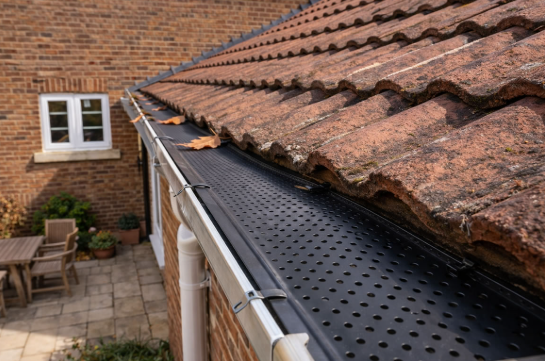
A guard is a filter. It changes what reaches the trough, and against broad leaves it genuinely works, since maple and cottonwood sit on top of a screen and blow off dry. Capacity is different arithmetic, because a five inch trough hung with two by three downspouts can only move so much water per minute before it jumps the front lip, while a six inch trough feeding three by four outlets moves considerably more of it. The case we see most often on a Sandy lot with four mature spruce is a system failing at both jobs at once, a screen holding a wet mat above a gutter too small to flush whatever slips underneath.
You can check part of this yourself before anyone quotes you. NOAA’s Precipitation Frequency Data Server, the free public portal behind Atlas 14, publishes short duration rainfall intensities for your exact address. Pair that with the roof area draining into each run and the sizing question stops being a matter of opinion.
See also: Epithalon: The Longevity Peptide, Explained
Needle Drop Defeats Screens Built For Leaves
Needles are small and stiff, shaped to weave. Mesh fine enough to stop them is also fine enough to blind over with pollen and asphalt grit, and once that film sets, water sheets across the guard and lands on the walkway instead of the downspout. Screens installed two years ago often make the clog harder to reach rather than less likely, because the mat now forms underneath a fastened panel. Pine needles do not read the brochure. Plan on two cleanouts a year under spruce. Honestly, closer to three, once you count the spring drop and the grit that washes down with it.
The overflow matters more than the clog does. Water that runs down a walkway and freezes there is a fall hazard, and a shaded Sandy driveway holds that ice for weeks. Do not set a ladder on ice, and never step onto an icy roof edge to reach a packed downspout; salt the walk, wait for a thaw, and clear the run from stable footing or hire it out. It is also why gutters Sandy UT homeowners ignore all summer turn into an urgent problem during one freezing week in December.
Materials And Sizes Compared Side By Side
Material is a durability and appearance decision, not a clog decision, because needles behave the same in aluminum as they do in copper. Sizing is the clog decision. Aluminum covers most Salt Lake County installs since it will not rust and it comes off the roll former as one seamless piece. Steel earns its spot under heavy snow load, and copper is a look you pay for, worth it on the right house and hard to justify on a rental.
General comparison for a needle heavy lot, not a price quote.
| Option | How Needles Behave | Maintenance Expectation |
| Aluminum seamless, 5 inch K style | Needles mat in the trough and pack at the outlet | Frequent clearing through autumn |
| Aluminum seamless, 6 inch with 3×4 downspouts | Added volume carries more needles to the outlet | Fewer full pack ups, still an annual check |
| Steel seamless | Same needle behavior as aluminum | Watch cut edges and fasteners for rust over time |
| Copper seamless | Same needle behavior as aluminum | Long service life, highest cost, patina develops |
| Fine mesh guard over 5 inch | Needles stay out, a film builds on the mesh | Surface sweeping plus panel removal to clean deep |
| Leaf screen over 5 inch | Needles pass through and mat underneath | Hardest to reach, the screen comes off first |
Read the middle column first. A six inch trough on a needle lot buys margin that no screen provides, and adding it during a full replacement costs far less than retrofitting it two winters from now. If the run has to stay five inch, spend the money on outlets and downspouts instead.
Questions To Ask Before Buying Gutter Guards
Guard sales lean hard on lifetime warranties, and that language usually covers the product staying attached rather than the gutter staying clear. Ask about needles specifically, not about debris in general. A crew that works wooded lots will answer in specifics, and one that does not will change the subject to financing.
- What does this guard do with pine needles specifically? A good answer names the mesh or louver style and admits what it will not stop.
- What trough size and downspout size are you quoting, and why that size? A good answer ties the number to roof area and local rainfall intensity, not to what is on the truck.
- How do I clean the gutter once this guard is installed? A good answer describes removal, reinstallation, and roughly how long a run takes.
- What does the warranty actually cover if the trough clogs anyway? A good answer separates the product warranty from any labor or clog promise.
Ask about capacity in that same conversation, because the guard pitch tends to swallow the sizing question whole. A June 2026 This Old House guide to choosing gutters put the pattern for wooded properties plainly, reporting that homes ringed by mature conifers clog 2 to 3 times a year, that guards reduce needle accumulation without ending it, and that moving up to six inch gutters adds capacity to carry needle fall and rainfall runoff together. That lines up with what comes off a spruce shaded roof here in a wet autumn. Nobody sells a system that never needs a ladder again.
Match The System To The Trees You Have
Start with the trees, not the catalog. Four mature spruce over a long run put more solid material into a gutter each fall than most guards are built to shed, so the trough and the outlets have to carry the difference. Fit a guard suited to needles rather than leaves, size the run and the downspouts to the debris load, hang everything at the right slope, and the twice a season packing stops defining your October. Measured first, that is a one day job. Skipped, it is a chore you repeat until something rots behind the fascia.